
About The Book
About The Book
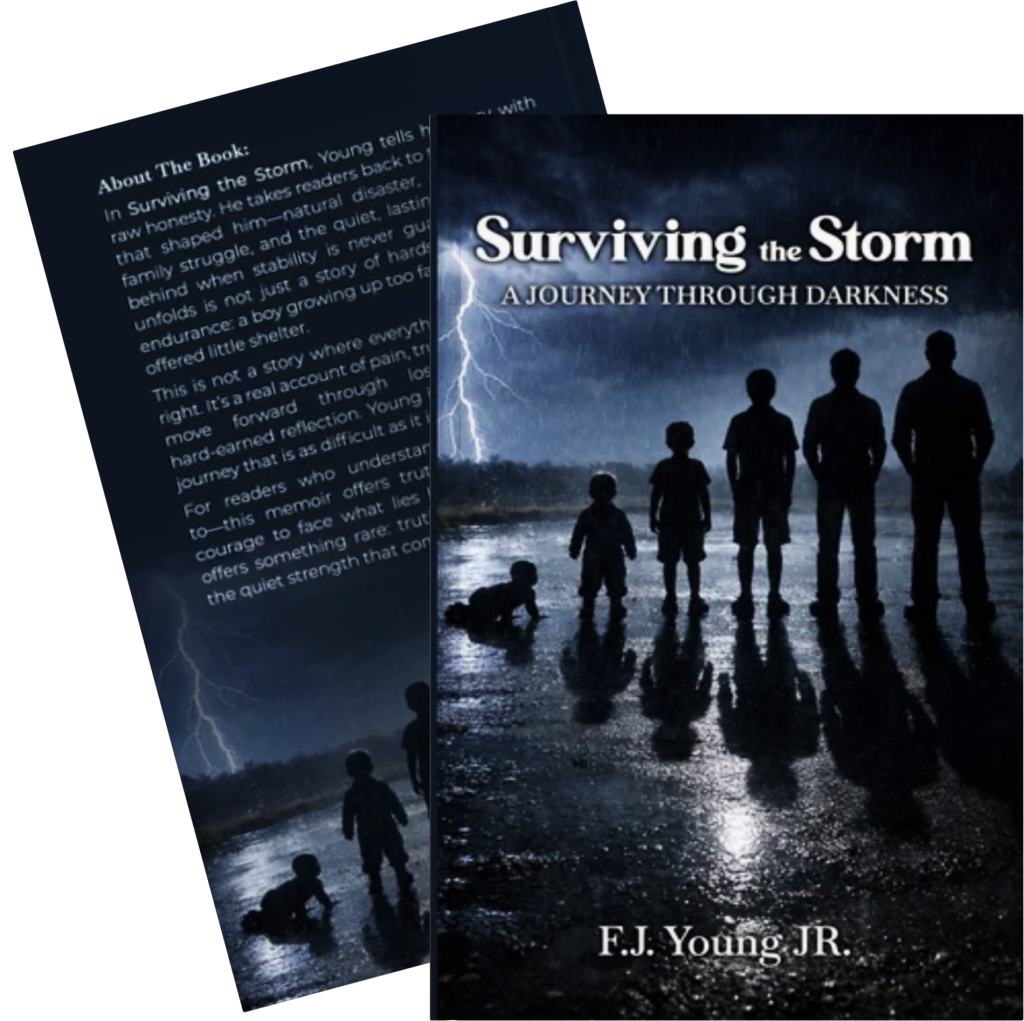
Surviving The Storm
This book presents a life story in its most honest form: unfiltered, complex, and deeply human. It begins in a childhood shaped by poverty, instability, and trauma, where survival was learned early and carried forward into every stage of life.
The narrative moves through defining moments: natural disaster, hunger, displacement, and emotional hardship. These early experiences build the foundation for everything that follows. As the story progresses, it expands into military service, where discipline and structure exist alongside internal struggle.
The journey does not stop there. It continues into the consequences of choices made under pressure, including experiences within the federal incarceration system. These chapters bring a deeper level of reflection, focusing on accountability, personal growth, and the reality of facing one’s past.
What sets this book apart is its intention. It is written to share, not to justify. To reflect, not to impress. Every moment carries a lesson: sometimes quiet, sometimes difficult, but always real.
Rather than offering a perfect narrative, the book presents a truthful one. It shows how early life experiences shape identity, how decisions carry weight, and how survival continues long after the initial struggle.
Choose Your Preference:
Chapters
Surviving The Storm
Floyd is born into a household already stretched past capacity—eleven children, poverty, and a mother (Evelyn) forced to govern through strictness because life offers no margin for error. The tornado that hits their home near 63rd & Classen becomes the family’s origin story of instability—sirens, freight-train roar, and the crib thrown against the wall seconds after a sibling grabs him. Survival in the bathtub becomes the first family ritual, but the aftermath brings displacement and the humiliation of needing charity to rebuild. When the Salvation Army supplies furniture, Floyd’s father (Frank) pawns it all for alcohol—turning disaster into betrayal and confirming that safety can be taken away overnight. The chapter establishes the memoir’s central pattern: chaos arrives loudly, abandonment follows quietly—long before Floyd has words for either.
The move to Coltrane Road tightens poverty into something physical: hunger that dictates behavior and a home environment where discipline substitutes for stability. Floyd’s siblings steal food—beans, rice—because morality becomes secondary to keeping children from going to sleep hungry. Foster care at Barry House introduces institutional fear early: small children learn to cling to adults and fight to keep even the smallest possessions. Returning home doesn’t restore innocence; it restores chaos—constant pressure, thin resources, and a child learning to disappear emotionally to stay safe. The chapter culminates in the bathroom fire that burns Mia, setting the foundation for Floyd’s protector identity and the lifelong bond that follows.
Constant moving becomes the rhythm of childhood—evictions, restarts, and the inability to build lasting friendships before another relocation wipes the slate. At Wilshire Apartments, the creek and mulberry bush offer a rare refuge—brief sweetness inside a life built on scarcity. Neighborhood hostility turns daily life into defense; bullying and bus stop violence become routine, especially with Mia too medically fragile to fight. Floyd develops a family “system” for survival—Lori fights, Floyd runs for help—training his nervous system to treat flight as problem-solving. The attempted runaway and brutal punishment crystallize a lesson that will echo for decades: escape is desired, but it comes with consequences.
A trusted family acquaintance (Bob Williams) enters as a helper—money for mowing lawns, treats afterward, the appearance of mentorship and care. Grooming escalates through small permissions: private conversations, lodge visits, “special” attention that feels like validation to a boy starved for it. The abuse begins in a setting associated with charity and legitimacy, creating confusion that later hardens into shame. Secrecy becomes enforced—framed as love, protection, and a “secret” adults wouldn’t understand—locking Floyd into silence. The chapter establishes the internal split that follows him into adulthood: outward normalcy masking inward fracture, with silence functioning as survival.
Mia’s health remains precarious even after earlier sacrifice, keeping fear alive inside the family system. News arrives that Floyd’s father Frank has been murdered—brutally—ending any possibility of reconciliation with a man who was mostly absence. The closed casket creates disbelief; Floyd pleads for proof, unable to accept death without seeing it. Meeting stepbrothers introduces rejection inside grief, sharpening the sense that family bonds are conditional and fragile. The unresolved case becomes another confirmation: systems fail, answers don’t arrive, and pain doesn’t require closure to take root.
Floyd meets Daniel, a friendship that briefly offers normal teenage belonging and a brotherhood he can choose. Returning to Oklahoma City and entering Capitol Hill High forces another reinvention—yet driving class becomes a rare pocket of confidence and control. Mia’s kidney fails again, dragging the family back into medical survival mode and reactivating Floyd’s protector vow. He fights the court system to donate a kidney as a minor; testing confirms an extraordinary match, making hope feel tangible. Mia dies before surgery, shattering Floyd’s identity as “the one who protects,” and he signs up for the Navy as a structured way to outrun grief.
Boot camp gives Floyd clear rules and measurable performance—structure that feels safer than childhood chaos. MM “A” School introduces isolation; he is young, shy, and hungry for belonging in a new environment. A Petty Officer builds trust through repeated attention and social invitation, repeating a familiar grooming shape under military authority. The assault occurs after heavy drinking; fear and shame collide with rank-based power, making reporting feel dangerous and futile. Floyd chooses silence and begins avoidance, weekend drinking, and early drug use—numbing that marks the beginning of a long self-medication cycle.
Orders to USS New Jersey place Floyd in Engine Room #3—heat, noise, danger, and a hierarchy where competence is survival. He starts at the bottom and learns the systems, finding pride in mastery and identity in responsibility. The engine room becomes a world where he can control outcomes—unlike childhood, where control never existed. Friendship with Patrick forms a rare emotional anchor—loyalty without interrogation, camaraderie without exposure. The chapter deepens the theme of “high-functioning survival”: performance becomes the mask that keeps the past sealed inside.
WHY READ IT
Surviving The Storm
This book offers something many stories avoid: Truth without filters.
It speaks to readers who understand that life is not always linear and that growth often comes through struggle, not comfort. From childhood trauma to military experience and the realities of incarceration, this journey provides a complete and honest perspective on survival.
It is especially relevant for readers looking for real-life experiences that go beyond surface-level storytelling. The book explores accountability, resilience, and the lasting impact of early life environments.
More importantly, it carries purpose. It is written to share lessons learned through experience, lessons that may resonate with those facing their own challenges.
This is not a story about perfection or easy redemption. It is about understanding, reflection, and the possibility of change.
For anyone searching for something real, something grounded, and something that offers both truth and perspective, this book delivers exactly that.